
Should Siblings in a Family Business Receive Equal Pay?

Two siblings can own the same percentage of a family business and still have very different jobs. One may be responsible for employees, customers, and the company’s financial performance, while the other works a limited schedule in a narrower role. If both receive the same salary, the arrangement may look fair to their parents and feel unfair to the person carrying more responsibility.
That disagreement becomes harder to resolve when salary is also being used to express love, reward loyalty, or make up for something that happened years earlier. Before debating a number, the family needs to agree on what the payment is for. Equal standing in the family, ownership of the company, and compensation for work are connected, but they answer different questions.
Separate the money before discussing fairness
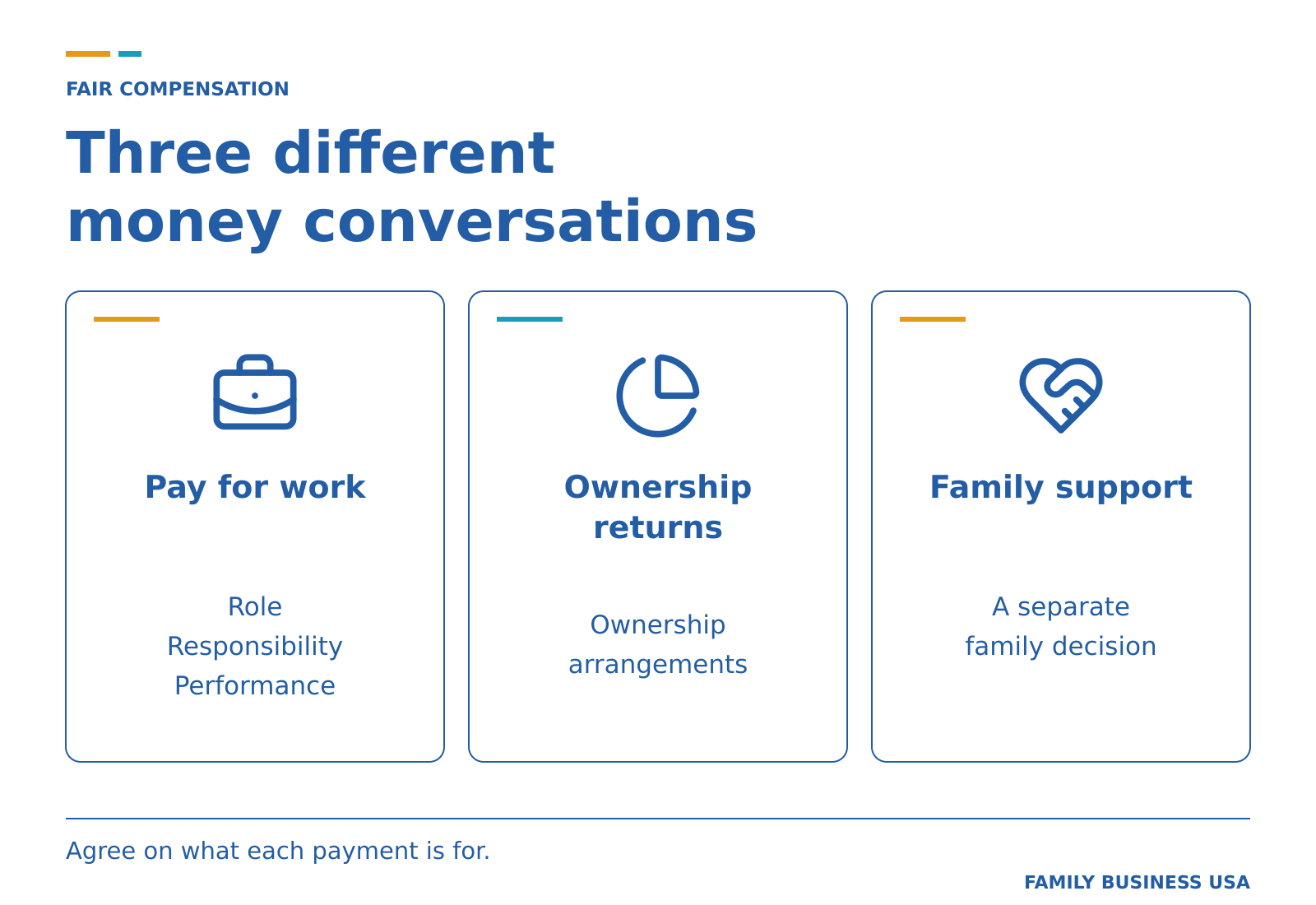
A useful starting point is to distinguish compensation for work from returns on ownership and personal family support. Salary and incentives should have an understandable connection to the role someone performs. Ownership returns are a separate discussion governed by the company’s arrangements and applicable requirements. A parent’s wish to help a child is another matter again.
Consider a hypothetical business owned equally by a brother and sister. The sister manages operations full time, while the brother has a career elsewhere. Their ownership interests do not disappear because their employment situations differ. At the same time, equal ownership alone does not establish that the business should pay them equal salaries.
The reverse also matters. A sibling working in the company should not assume that a relative outside it has no legitimate interest in business information or ownership decisions. Those questions belong in the family’s ownership alignment discussion, rather than being settled indirectly through payroll.
Define each job before evaluating the person
When a compensation conversation starts with who deserves more, family members can quickly begin defending their history. A more productive starting point is the work the business needs and the responsibility each person actually carries.
Write a current description of each role, including decisions, reporting relationships, expected results, and the time commitment. Then ask what qualifications the role requires and what the business would reasonably pay someone outside the family to perform comparable work. Relevant market information helps ground the conversation, although it cannot replace judgment about the particular business.
For the sibling who has quietly absorbed extra responsibilities, this makes the additional work visible. For someone whose title has become larger than the job, it provides a way to discuss the mismatch without making the conversation a judgment of that person’s value to the family. The same approach should inform expectations for non-family employees.
Different salaries can be reasonable when responsibilities differ. Similar roles and performance may justify similar compensation. The explanation should be one the business can apply consistently, rather than a rule invented to justify a preferred person’s pay.
Agree on the process before negotiating individual salaries
Even a well-supported pay recommendation can become another source of conflict if one sibling controls the information and announces the answer. Family members need to understand who gathers the evidence, who makes the decision, and how someone can raise a concern.
Research discussed by Roland Kidwell, Anneleen Michiels, and Isabel Botero on executive compensation in family firms highlights the importance of discussing pay expectations before a dispute forces the issue. Their work also cautions against assuming that findings from large public companies apply neatly to privately held family businesses.
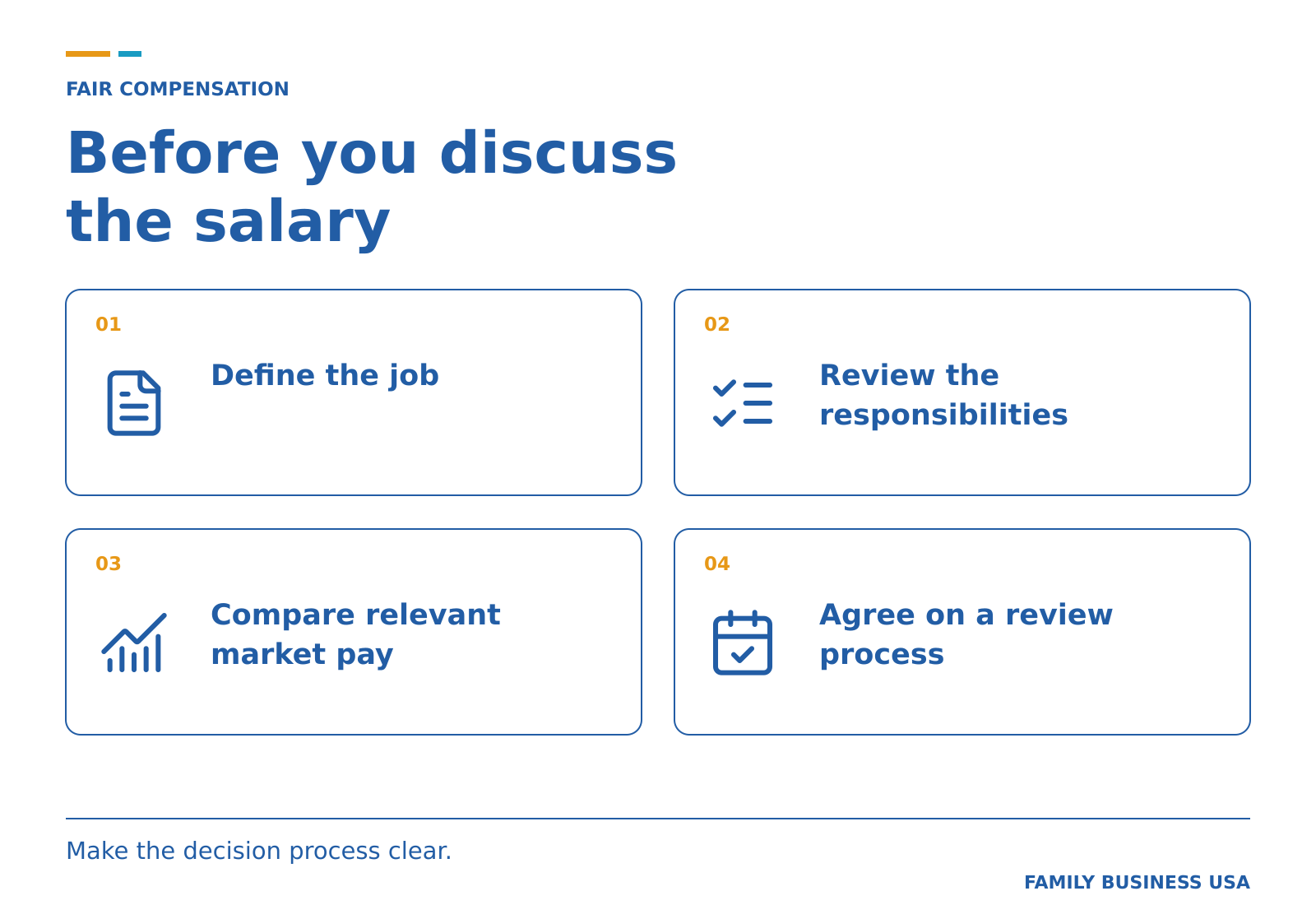
A practical process can begin with four questions:
- What responsibilities and results will determine compensation?
- What information will be used to evaluate the role and performance?
- Who can review the recommendation without deciding their own pay?
- When will compensation be reconsidered, and how will disagreements be addressed?
The people affected should have a chance to explain their understanding of the arrangement. That does not mean everyone must approve every salary. It means the decision process is clear enough that disagreement can be addressed without turning every review into a family negotiation.
Deal honestly with an arrangement that has become unfair
Some families recognize a problem but keep an old pay arrangement because changing it feels unkind. Others want an immediate correction after years of frustration. Neither reaction resolves the practical question of how to move from the current arrangement to a defensible one.
Start by understanding how the existing compensation developed. Was it tied to an earlier role? Did someone take on additional work without a review? Has a personal financial need become an assumed business obligation? These explanations do not automatically justify continuing the arrangement, but they matter when planning a change.
A transition should account for the company’s circumstances, employment commitments, and the people affected. Obtain appropriate employment, accounting, or legal guidance for changes that require it. The aim is a workable compensation process, rather than a hurried adjustment that creates another dispute.
It is also worth asking whether the salary disagreement is carrying a different complaint. A sibling who says they are underpaid may feel that their work is invisible. Someone resisting a change may fear losing their place in the family. Those concerns deserve a direct conversation alongside the business analysis.
Give the next generation an explanation it can understand
An arrangement that only the parents can explain will become more difficult when cousins join the business. Each branch may expect its children to receive the treatment the previous generation received, even when the jobs and business needs have changed.
Put the principles in writing before the next hiring or promotion decision. Explain how relatives enter the company, who supervises them, how performance is reviewed, and how compensation is determined. The document should record a conversation the family has actually had, with room for questions and future review.
For broader context, our article on financial conflict in family businesses covers the ways pay disagreements can overlap with spending, distributions, and ownership. The immediate task here is more specific: make compensation explainable without asking a salary to carry the entire meaning of fairness in the family.
If that conversation repeatedly ends in accusation or silence, family business conflict resolution support can help the family examine the responsibilities and relationships behind it.
Frequently Asked Questions
Should siblings who own equal shares earn the same salary?
Equal ownership alone is not a sufficient reason for equal salaries. Compensation should be considered in relation to each person’s actual role, responsibilities, and contribution. Ownership returns require a separate discussion consistent with the company’s governing arrangements.
What if one sibling does not work in the business?
Separate that person’s ownership position from employment. A relative who does not perform a job should not automatically receive a salary because another owner does. Their ownership rights and any distributions are separate matters that need clear agreements and appropriate professional guidance.
How should a family discuss a sibling who is paid more than their role supports?
Begin with an accurate description of the role, compensation information, and an agreed review process. Let the person explain their understanding before proposing changes. Avoid treating a pay adjustment as punishment for unrelated family disagreements.
Who should decide compensation when family members disagree?
Use a clearly assigned decision-maker or review process with appropriate independence. Depending on the company’s structure, that may involve its board, an independent advisor, or designated management. Family discussion can inform the decision without making compensation a contest over who has the strongest personal influence.
If your family is struggling to separate pay, ownership, and expectations, request a confidential consultation with Family Business USA to discuss where the conversation is getting stuck.
Sources
Henry Hutcheson. Dirty Little Secrets of Family Business: Ensuring Success from One Generation to the Next (3rd edition). Perspective on compensation, ownership, and family expectations.
International Finance Corporation: Family Business Governance Handbook. See Section II, family-member employment policies, including the SABIS example’s compensation provisions. Institutional background on separating pay for work from returns on ownership.